
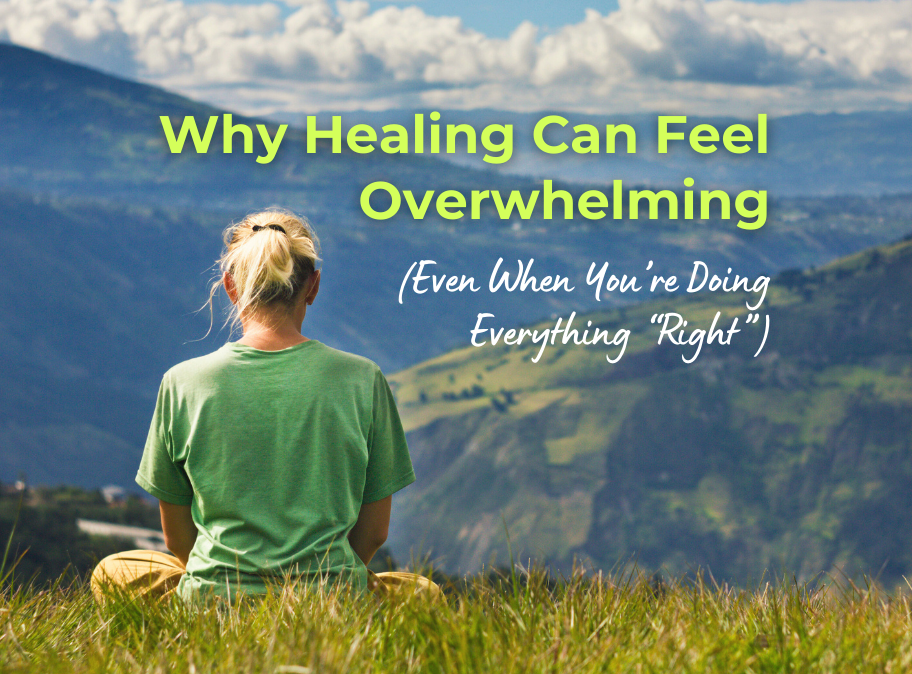
Why Healing Can Feel Overwhelming (Even When You’re Doing Everything “Right”)

When healing starts with hope — and then feels overwhelming
Many people come to healing because something in their life has reached a breaking point. There’s pain that keeps resurfacing, patterns that won’t shift, or a sense of being stuck despite years of effort. When you finally find tools that seem meaningful—therapy, meditation, spiritual practice, inner work—it often brings relief at first. There’s hope. Things begin to make sense.
And then, for many people, something unexpected happens.
Instead of feeling better, healing starts to feel overwhelming. You become more aware, but also more tired. You notice more emotional movement, but not necessarily more ease. Rather than feeling supported by the process, you feel consumed by it. That’s usually when doubt begins to arise: Why does this feel harder? Am I not doing this right?
The phase no one really talks about
This experience is more common than most people realize, and it’s rarely talked about honestly. Healing is often described as liberating or empowering, but very few people mention the phase where it becomes exhausting—where it feels like everything in your inner world suddenly demands attention all at once.
At that point, healing can start to feel like a constant obligation. Every emotional reaction feels significant. Every uncomfortable moment feels like something you should work through immediately. You may find yourself monitoring your inner state throughout the day, replaying interactions, scanning for triggers, wondering whether you’re missing something important if you don’t address it right away.
When awareness turns into doubt

Over time, that level of constant checking takes a toll.
People often describe feeling worn down rather than strengthened. There’s discouragement, and sometimes a subtle sense of failure. You might notice yourself comparing your progress to others, wondering why you’re still dealing with the same issues.
Over time, that level of constant checking takes a toll.
People often describe feeling worn down rather than strengthened. There’s discouragement, and sometimes a subtle sense of failure.
You might notice yourself comparing your progress to others, wondering why you’re still dealing with the same issues.
The original pain becomes layered with self-doubt, which can feel more challenging than what brought you to healing in the first place.
The original pain becomes layered with self-doubt, which can feel more challenging than what brought you to healing in the first place.
The assumption that keeps people stuck
When that happens, most people draw the same conclusion: I must need to do more.
More self-analysis.
More effort and practice.
More layers to clear.

When that happens, most people draw the same conclusion: I must need to do more.
More self-analysis.
More effort and practice.
More layers to clear.
Healing culture often reinforces this idea, suggesting that if something hasn’t shifted yet, it’s because you haven’t gone far enough. So people push harder. They add more practices, dig more deeply into analysis, and spend more time trying to get to the root of what’s wrong.
This is usually the point where the process starts to work against itself.
Why more effort doesn’t always lead to more relief
Healing becomes overwhelming when everything feels urgent and nothing has time to settle. When every emotion is treated like a problem that needs immediate attention, the system never really gets a chance to rest. Awareness turns into mental strain. Reflection turns into an overactive attempt to solve something that isn’t actually a problem in that moment. Instead of creating space, the process spirals.
At that point, healing is no longer something that supports life. It becomes something life has to revolve around.
Awareness is the cornerstone of healing. In my Ecstatic Union™ system, I teach a simplified, grounded approach called Tantric Awareness, which helps you reconnect with your True Self and process emotional pain without overwhelm. This practice combines grounding, emotional clarity, and presence to help you face emotional pain without getting stuck.
This practice combines grounding, emotional clarity, and presence to help you face emotional pain without getting stuck.
The deeper issue beneath the exhaustion
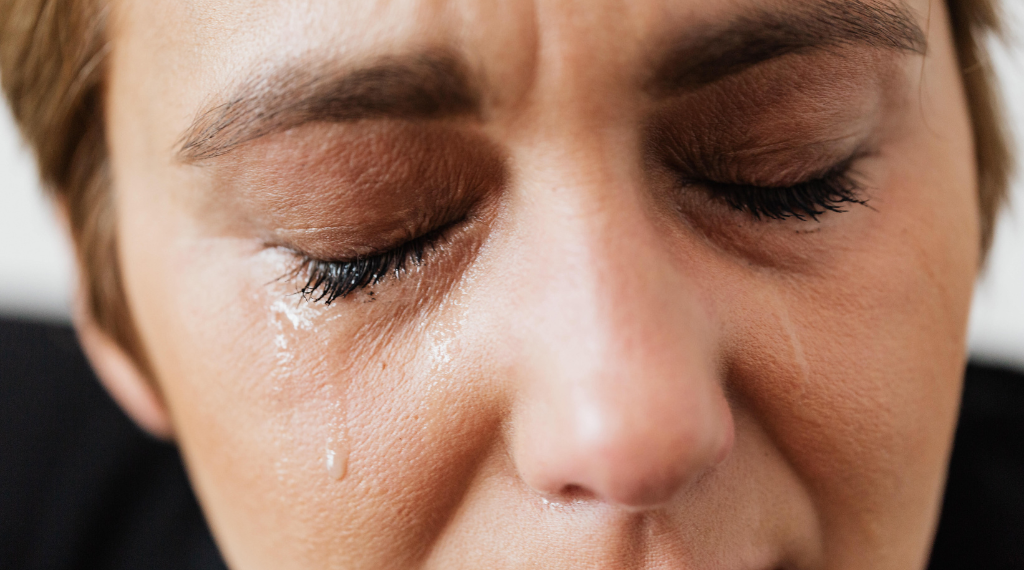
The deeper issue usually isn’t that someone is healing incorrectly. It’s that healing has quietly become a full-time project. Pain moves to the center of attention. A subtle sense of being broken or in need of fixing starts to shape how you see yourself. Any sense of ease gets postponed until everything is resolved.
Without realizing it, people begin to define themselves by what hurts rather than relating to it with some distance.
That approach isn’t sustainable, and it isn’t how lasting change happens.
When healing shifts from fixing to feeling
Healing tends to work better when it isn’t driven by urgency. That doesn’t mean ignoring pain or avoiding difficult emotions. It means allowing enough safety and support for things to unfold gradually, without turning every feeling into an inner struggle.
Real progress usually comes from being present with what’s here, allowing emotions to arise without trying to suppress or correct them, and recognizing that being human includes experiencing discomfort. That capacity comes first. Change follows.
What changes when self-acceptance enters the picture
When healing is approached with a slower pace, context, and support, it no longer has to dominate your life to be effective. Some things can remain unresolved for a while without causing harm. Life doesn’t need to be put on hold while you work on yourself. In fact, healing often integrates more naturally when it unfolds alongside daily life rather than replacing it.
This is where many people notice a real shift. As the internal push to “fix yourself” softens, there’s often a sense of relief. Self-blame eases. Trust begins to return—not because all struggles have disappeared, but because the process feels more natural and less exhausting. Instead of asking What’s wrong with me?, the question becomes What would actually support me right now?
Can you relate to this?

If this sounds familiar, it doesn’t mean you’ve failed or fallen behind. It often means your system is asking you to slow down and recognize that intensity doesn’t make healing happen faster or deeper. In most cases, it does the opposite.
If this sounds familiar, it doesn’t mean you’ve failed or fallen behind. It often means your system is asking you to slow down and recognize that intensity doesn’t make healing happen faster or deeper. In most cases, it does the opposite.
What actually helps is support and a more gentle relationship with what you’re experiencing, rather than more effort.
What actually helps is support and a more gentle relationship with what you’re experiencing, rather than more effort.
Healing doesn’t require constant pushing to be effective. It requires the right conditions.
This is one of the reasons EcstaticU exists—to offer a space where growth doesn’t depend on urgency or self-pressure, and where healing can unfold in a way that genuinely supports your life. You don’t need to have everything figured out to participate, and you don’t need to be “better” before you begin.
If you’ve been carrying the sense that you should be further along by now, consider this an invitation to reevaluate. Nothing has gone wrong. You may simply be ready for a different relationship with healing—one that leaves room for integration, consistency, and real relief.
Healing doesn’t require constant pushing to be effective. It requires the right conditions.
This is one of the reasons EcstaticU exists—to offer a space where growth doesn’t depend on urgency or self-pressure, and where healing can unfold in a way that genuinely supports your life. You don’t need to have everything figured out to participate, and you don’t need to be “better” before you begin.
If you’ve been carrying the sense that you should be further along by now, consider this an invitation to reevaluate. Nothing has gone wrong. You may simply be ready for a different relationship with healing—one that leaves room for integration, consistency, and real relief.